



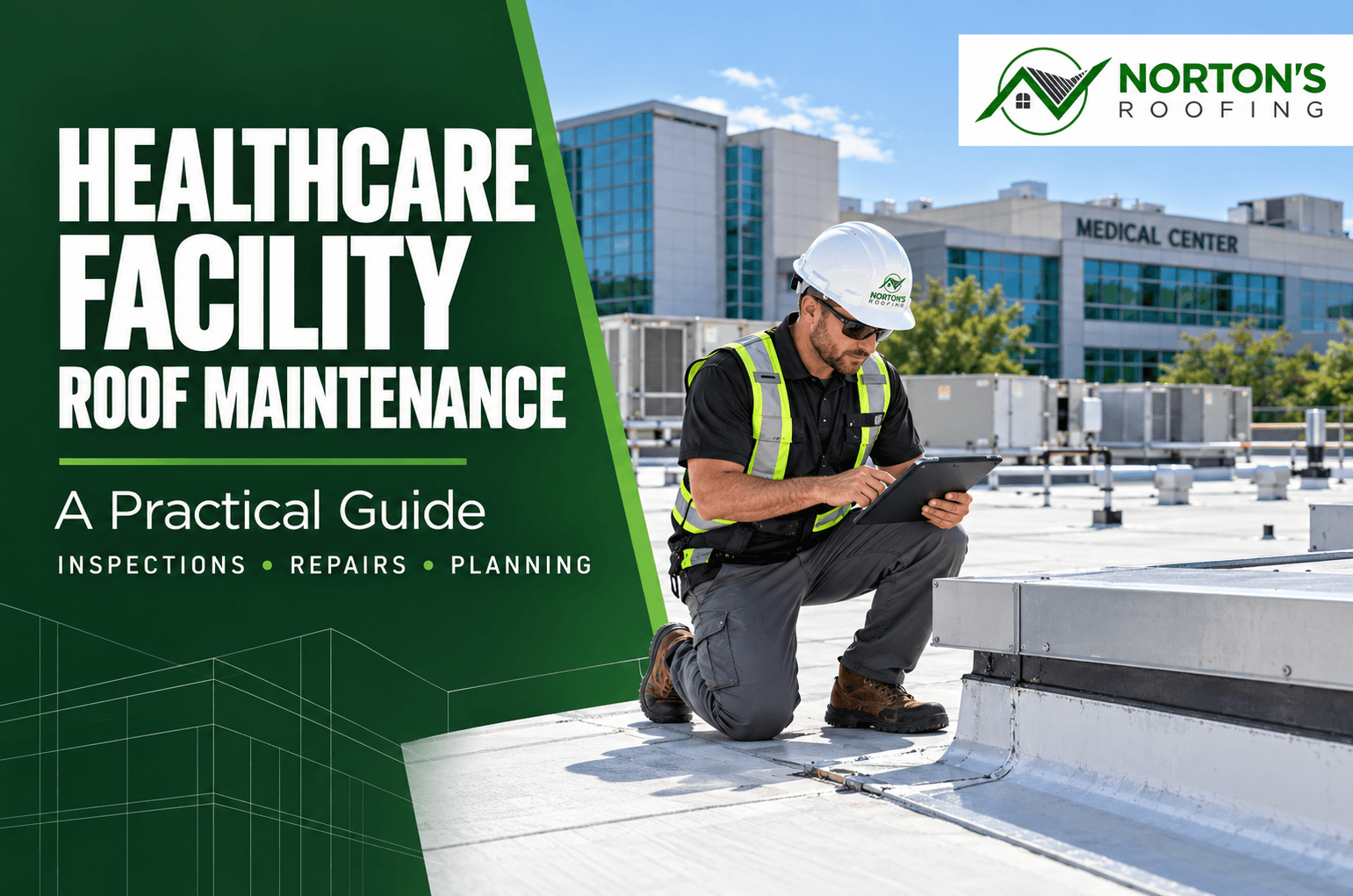
A roof leak at a medical building can disrupt appointments, damage equipment, and take patient care areas out of service. Waiting for visible water damage leaves facility managers with fewer options and more pressure to act quickly.
Healthcare facility roof maintenance should combine scheduled inspections, prompt repairs, clear documentation, and coordination with clinical teams. For hospitals, outpatient centers, and medical offices, the goal is to identify roofing problems early while planning work around the people and services inside.
How Often Should Healthcare Facility Roofs Be Inspected?
A practical starting point is a professional inspection in spring and fall, with additional checks after severe weather or work involving rooftop equipment. Adjust the schedule to the roof manufacturer’s requirements, warranty terms, local conditions, and the building’s maintenance history.
The National Roofing Contractors Association’s reroofing guidance recommends inspections at least twice a year and after severe storms. This is a maintenance baseline, rather than a universal healthcare compliance requirement.
| When to inspect | What to focus on |
|---|---|
| Spring | Winter damage, loose flashing, blocked drainage, and membrane condition |
| Fall | Debris removal, drainage performance, and repairs needed before winter |
| After severe weather | Displaced materials, punctures, damaged edges, and new leaks |
| After rooftop equipment work | Damage around access routes, equipment supports, and penetrations |
| When an interior warning appears | The leak source, affected roof assembly, and impact on occupied spaces |
Older roofs, recurring leaks, and roofs above critical departments may justify more frequent professional reviews. Make inspection frequency a documented decision based on condition and operational risk.
What Should a Roof Inspection for Hospitals Include?
An inspection should assess the roof as a complete system. Looking only at the visible surface can miss problems at drainage points, equipment connections, or roof edges.
Ask the contractor to examine:
- Roof coverings: Punctures, splits, open seams, blisters, or other deterioration appropriate to the roof type.
- Flashing and penetrations: Connections around vents, pipes, curbs, skylights, and walls.
- Drainage: Drains, gutters, scuppers, downspouts, and evidence of persistent ponding.
- Edges and transitions: Copings, perimeter details, expansion joints, and changes in roof level.
- Equipment areas: Supports, service routes, and damage associated with rooftop access.
- Interior conditions: Ceiling stains, damp materials, and the location and timing of reported leaks.
The report should include photographs, a roof plan showing findings, recommended actions, and repair priorities. Where concealed moisture is suspected, ask whether additional investigation is appropriate. A surface inspection alone cannot establish the condition of every underlying layer.
Plan Hospital Roof Repair Around Patient Care
Hospital roof repair requires coordination beyond the roofing crew. Before work begins, bring facilities staff, infection prevention personnel, clinical leaders, security, and the contractor into the planning process as appropriate to the project.
CDC environmental infection-control guidance calls for multidisciplinary coordination and an infection-control risk assessment before relevant construction or repair activities. The facility’s team should determine the precautions needed for the scope and location of the work.
Resolve these practical questions before mobilization:
- Which departments are beneath or beside the work area?
- Could noise, vibration, dust, odors, or debris affect operations?
- Where are nearby outdoor air intakes and exhaust outlets?
- How will workers, materials, and waste move through the site?
- What temporary weather protection is needed?
- Who can authorize a work stoppage if conditions change?
Any proposed adjustment to ventilation must be reviewed by qualified facility personnel. Roofing work should not trigger an unplanned change to systems serving sensitive patient areas.
For a building operating around the clock, a phased schedule may be more workable than a single large work zone. Define each phase, its daily closeout requirements, and the communication process for affected departments.
Prioritize Repairs by Risk and Condition
A useful healthcare facility maintenance plan separates urgent problems from scheduled repairs and longer-term replacement needs.
Urgent response: Active water entry, loose materials, or suspected structural damage requires prompt assessment. Notify the facility’s response team, protect affected areas under its procedures, and arrange professional evaluation.
Scheduled repairs: Localized seam defects, deteriorated flashing, and other repairable conditions should receive an owner and target date. Confirm that the proposed materials and methods are compatible with the existing roof.
Capital planning: Repeated leaks, widespread deterioration, or substantial moisture within the assembly may warrant a broader repair, restoration, or replacement evaluation.
Consider the space below each defect when setting priorities. A problem above an equipment room or treatment area may carry different operational consequences from a similar defect above an unoccupied storage area.
Compare Medical Building Roofing Options
There is no single best roofing material for every healthcare property. The right system depends on roof slope, existing construction, drainage, rooftop traffic, climate, installation constraints, and the facility’s budget.
Common medical building roofing options to discuss with a qualified contractor include:
| Roofing option | Questions to ask during evaluation |
|---|---|
| TPO | Is the proposed assembly suitable for the building, and how will seams and penetrations be detailed? |
| PVC | Are its documented properties appropriate for the rooftop exposures and intended application? |
| EPDM | How will attachment, seams, drainage, and service access be addressed? |
| Modified bitumen or built-up roofing | Which installation method is proposed, and what operational precautions will it require? |
| Metal roofing | Is the roof geometry suitable, and how will movement, penetrations, and drainage be managed? |
| Roof coatings | Is the existing roof a suitable restoration candidate, based on adhesion, moisture, and condition assessments? |
A coating should not be treated as a universal solution for leaks or deterioration. The contractor should establish suitability before recommending it.
Compare complete proposals rather than material names alone. Insulation, flashing, drainage details, attachment, installation quality, and maintenance access all belong in the decision.
Build a Maintenance Budget With Clear Records
Facility management for healthcare becomes easier when roofing information is accessible and current. Maintain a file for each building or roof section containing:
- Installation date, roof type, and available warranty documents.
- Inspection reports and photographs.
- Leak locations and repair history.
- Records of rooftop equipment changes.
- Outstanding repairs, responsible parties, and completion dates.
- Estimated future repair and replacement needs.
Separate routine maintenance spending from larger capital projects. Ask for a condition-based forecast with stated assumptions, rather than relying on roof age alone.
Review the file after storms, repairs, and equipment installations. Consistent records help managers recognize recurring problems and explain funding requests.
What to Ask a Roofing Contractor
Before approving work, ask how the contractor will document conditions, protect occupied areas, coordinate with facility teams, and manage temporary weather protection.
Also confirm relevant insurance, applicable licensing, manufacturer requirements, and any subcontractor responsibilities. For healthcare projects, request examples of comparable occupied-building work and discuss the facility’s access and infection-control procedures.
The proposal should make the scope, exclusions, schedule, communication responsibilities, and closeout documentation clear.
Plan Your Next Roofing Assessment
An effective roof maintenance program gives healthcare facility managers a clear view of current conditions and the next actions required. Start with an inspection, prioritize the findings, and coordinate repairs around the building’s operational needs.
Contact Nortons Roofing to discuss your medical building’s roof condition, repair concerns, and maintenance priorities.
Frequently Asked Questions
How often should a hospital roof be inspected?
Twice-yearly professional inspections are a practical starting point, supplemented by checks after severe storms, rooftop work, or new signs of leakage. Follow applicable manufacturer and warranty requirements and adjust the schedule to the building’s risk profile.
Can roof repairs happen while a healthcare facility remains open?
Some repairs can proceed in occupied facilities, depending on the scope, location, and safeguards. Facility leaders, infection prevention staff, and the contractor should assess the work and agree on precautions before it begins.
Does every roof leak require replacement?
No. A localized defect may be repairable. Recurring leaks or broader deterioration require investigation to determine whether repair, restoration, or replacement is appropriate.
What is the best roof for a medical building?
The best option is the system that fits the building’s construction, exposures, operational needs, and maintenance plan. Compare complete assemblies and installation proposals with a qualified roofing professional.


Josh Norton
About Author
Starting from a passion for home improvement, I founded Nortons Roofing with a strong belief in the importance of every home being beautiful. With extensive experience in roofing and siding, I am committed to improving the protection and appearance of your home. Through this blog, I look forward to sharing my expertise to help you make informed decisions for your next exterior renovation project.